Showing posts with label Fish. Show all posts

5 August 2014

Spaghetti with jamon serrano, sea bass and garlic prawns. If you were an expat...

It was Friday night and as I watched the Spanish movie "Atlas de geografia humana", based on the novel of my favourite Spanish writer, Almudena Grandes, I was transported to Spain. A deep forgotten part of my heart got very excited and suddenly awake.

I rented this movie, for free, from  the Spanish Resource Centre, an office that belongs to the Spanish Embassy in Canberra. Since I left Spain in 2003 and moved to Australia, alas I was officially an expat, this Spanish office was like a "bridge" between my beloved Spain and  the isolated Canberra.  

But not only this Centre became a refuge for my early days in Canberra, also the Spanish Australian club was an important part of my life in the Australian Capital, and still is - specially when there are chocolate with churros for 5 dollars served the day that Oscar comes with his van stocked up with embutidos such as chorizo, jamon, queso Manchego, and even bags of pulses, cans of sardines, pimientos de piquillo, green olives and Nenuco, a cologne of my childhood that my mum used to pour over my hair before leaving home to go to school!!-.

 Established in 1967, to gather the Spanish community in Canberra


 Oscar behind the chorizos and salchichones...the smell of this delicatessen invades the whole club! it is mouth watering for a non-vegeterian like me

Old people ordering anis con hielo (pastis with ice), quite a strong drink to have at 8am! My husband and his friend Jona had also one, just "to fit into the club atmosphere", he said under my suspicious eyes

 It needs to be updated...perhaps the news didn't get to the club yet

If you were an expat, perhaps you will will identify yourself with some of the comments of this post. Let me explain. 

More than 10 years ago, in April of 2003, I started my life in Canberra (and since then, I have been back 4 times for no more than 15 months each time). During that year I held my "spouse visa", took an English course for new immigrants in  the Canberra Institute of Technology, learnt to drive with a personal teacher called Banjo -imagine Sylvester Stallone but in the Australian version- and covered in tattoos of bloody skulls and black roses. Besides, I worked part time as a Spanish teacher during the day and as a waitress in the evening in a Spanish restaurant, Legends, which to my surprise still survives in the snobby suburb of Manuka.

Those were the months when I had terrible homesickness and felt very lonely in this multicultural society, an adjetive that the Australians are proud of it. During my first period in Canberra before I moved to Solomon Islands in 2004, I didn't understand why I couldn't fit into that society. I tried my best but it was never enough. I know the language barrier was one of the main factors, as I mentioned in my post of "Sorry, I don't understand you".  Indeed, my lack of any linguistic skills made my life more difficult in Australia and even in Solomon Islands, where the environment was in English.

Who would it thought I would be given the  Australian citizenship in 2010? Now that I am dealing with some past events of my life, it is me who is proud!

Anyway, that's a different story but it serves me as a background to explain you how I felt when I was a new Spanish expat in Australia, still very attached to my culture, and how this connection to my country has been "hidden" within the 11 years I have been away from Spain by moving and adapting myself to different cultures not quite similar to mine. 

For me, being an expat reminds you that, despite of moving around the world, there is still an essential part of who you are and where you come from. It is intrinsic to your family name, your origin, your past, your childhood and even your future. Being an expat is special, delicate and fragile.

I miss Spain, to be honest. I know many of my Spanish friends think I am lucky to live this diplomatic life. And I agree with them, I am very lucky and love it. I wouldn't change it for anything. However, I can't help it and when I think of Spain, a wave of nostalgic and jealousy for not being there gives me goosebumps. Truth be told, when you are an expat, there is a natural tendency to idealise everything. When I say everything, believe me, I talk from my own life experience. 

I am very enthusiast when I meet other Spanish people, so much that I take them as my best friends; I tend to speak Spanish very fast if I have the chance to use it with other natives -and even my sense of humour is different!!-  and of course, I am in heaven if you take me to see a flamenco show, my hands immediately start clapping and my feet moving and "taconean" shyly.

And last Friday, when I was watching the movie "Atlas de geografia humana", I had an awkward moment when I was crying and laughing at unison - a couple of glasses of Tasmanian wine also played an important role-.

That's what being an expat gives you: the pleasure of having a good cry for something that makes you really, really happy.


When I look backwards I realise that I should look forwards instead because my Spanish identity goes in my blood and into my children's. Like the roots of a robust olive tree stay strong, seeing the years pass by, from generation to generation, the same happens to your family...

Gabby and Aurelia eating churros, and said yummy in my tummy!!!!!!


This dish was based on the recipe of Neil Perri "Spaghetti with lobster and fish" but I made my own version using the succulent jamon serrano from Oscar (instead of prosciutto ) with its distinctive sweet flavour, prawns marinated in garlic and olive oil (no lobster, obviously) and I panfried the fresh fish (Neil Perri cooks it with the tomato sauce),

Let me tell you that this dish was a total winner with my fussy son Gabriel who didn't notice the fish in the pasta thanks to the tomato sauce. It is a great recipe for leftover white fish you might have in the fridge as long as the tomato sauce you use is good because it is the base, better if you make it at home.

It takes an hour to make the tomato sauce, the rest 20 minutes, including cooking the pasta. We have had it tonight, while Nick is in Perth, and I literally cook it in that time. I felt I was in Master chef with the clock going against me and three little, and anxious, mouths waiting for the verdict.
  1. Make the tomato sauce: I fry quickly 4 big garlic cloves, thinly cut, in a deep pot covered with a layer of olive oil.  Add then 2 big cans of diced tomatoes, sprinkle salt and brown sugar, black pepper, stir and leave it partially covered with the lid. After an hour, you will see the oil has risen above the tomato. It is done. Pour some extra virgin olive oil and mix it through.
  2. In the mean time, chop more garlic to marinate a handful of prawns, shelled, deveined  and chopped into 1 inch or so. Season the prawns. In a bowl, mix the garlic with 1/2 cup of extra-virgin olive oil. Add the prawns to the bowl and leave them to soak the flavours until the tomato sauce is finished.
  3. Put the water with salt for the pasta.
  4. Meanwhile, panfry the white fish, chopped and set it outside.
  5. Thinly cut a few slices of jamon serrano, and keep them on a plate.
  6. Fry the prawns in a very hot and smoky  pan until they are nicely cooked through.
  7. Cook the pasta until al dente.
  8. Put the spaghetti back to the pot, add the tomato sauce (not all of it, just to cover the pasta), the jamon, the fish and the prawns. Mix it through and eat immediately. Italians do not like to add parmesan cheese to seafood pasta dish, but I do.




13 January 2014

Seafood paella. Home, sweet home...except the jet-lag

Happy New Year! One of my resolutions for 2014 is to cook more often the same dishes instead of looking for new ones constantly. Only when I have mastered simple meals, I will be more adventurous with techniques. 

Anyway, I always feel a bit down when I have to pack up the beautiful Christmas decorations. "Bye bye, see you next year...." I say to myself. I become a five year old child while I am wrapping the delicate silver crystal balls and place them gently in to the box. This box will be opened again, this December of 2014 in a different country from the Philippines. I feel little butterflies of excitement thinking about the idea of moving again in June.

I haven't written for 3 weeks and I have missed it, specially the quiet time of being alone in front of my blog. How hard could it be? Well, if you have had a week of Christmas celebrations from the beginning of December, your parents in-law visiting, a trip to Spain from the 27th of December until the 9th of January, with a  full time schedule of family reunions plus the celebration of los Reyes Magos (or the Three Kings), yes, it has been almost impossible. SILENCE is a word much needed for me after Christmas, like a detox program people do at the beginning of the year. 

Besides, I am a bit grumpy because I am struggling with the jet lag after coming back from Spain. No, not mine, it is Juanan's!  For the last 3 days, Juanan has decided to play with his feet, to make very loud noises that some would call "baby talk" and to have a good time until 3 or 4 in the morning. I have tried to stuff the dummy with sticky tape in his sweet little mouth but somehow he spit it out. Nope, it hasn't worked to make him sleep at a reasonable hour and he is wide awake. I am starting to become unreasonable myself during the day due to these late nights.

How am I coping with the jet lag? In the last few mornings I wake up at 10am and have such a strong cup of coffee that it could wake up a dead body and in the evenings, while I am so frustrated and about to cry because it is 1 or 2am and Juanan doesn't want to sleep, I read The Tabla Esmeralda book that I downloaded in my new sony reader that the Reyes Magos, on behalf of Nick ( without his knowledge!) bought for me. I am a total convert. I can say bye to the heavy Spanish books I used to bye and bring  in my suitcase. This small useful gadget has changed my life.

I have so much to tell and share that I need a few posts to go through. But for now, you are going to  have to forgive me, I blame this dammed jet lag that stops me for going back to my normal daily routine. Temporarily, of course. 

I cooked a seafood paella for Nick's parents on Christmas Eve. To be honest, paella depends on many factors: the fish or chicken you use, the stock you make (do not use cubes for this dish...), the fat round rice ( Calasparra is the best but Arborio will do the trick), the size of the paella dish and above all, the cook. 

I know the last factor sounds obvious, but it wasn't for me for many years. I can give you the recipe, like my dad gave it to me, but your paella won't be the same as mine (maybe it will be even better!). I don't know how many paellas I have cooked in my life, trying to repeat each step or tip my father taught me. I even place a page of the newspaper on top of  paella when the socarrada (or the burnt bottom part of the paella ) is done to finish cooking the rice that is on top. Like my dad used to do.

My paellas are never the same: some are good, some are tasteless. And they don't have that distinct flavour that made my father's paella so famous. His paella was particular, special. Nick says it was unique because my dad smoked while he was making it and perhaps part of the ashes dropped in to the rice!. Probably, lo que no mata engorda.

However, there is a common element in all of the paellas I have made in the past, I feel my dad's presence ( even the smoke of the cigarette! ) although he passed away a few years ago. That's probably why I find cooking so fascinating because you can actually recreate memories of people, places, moments. Only then, eating and sharing food makes sense to me.

This paella was one of the good ones, by the way. Thanks dad.


Serves 10 people
  • 2 brown onions, chopped
  • 4 garlic cloves, chopped
  • 1 big red capsicum, chopped
  • 1 cup homemade tomato sauce or 1 can of diced tomato
  • 12 tiger prawns, some peeled and deveined and some whole unpeeled for the top of the paella
  • 3white fish fillets
  • 200 g mussels, cleaned and beard removed
  • 1/2 cup green peas (frozen are fine)
  • 3 cups arborio rice
  • 7 cups of fish stock
  • Azafran or yellow colorante (or a bit of turmeric )
  • Sea salt
  • A can of roasted red capsicum, cut it in stripes
  1. Heat the paella dish to medium high heat and add a lug of olive oil. Fry the capsicum until brown and soft (2 minutes) stirring all the time. Set it aside.
  2. Add a bit of oil again, and add the onion and garlic, fry until soft. Be careful the garlic doesn't get burnt. Set aside.
  3. If you are using homemade tomato sauce, add it to the pan and give it a stir. If you use the can, fry some chopped garlic and  then add the diced tomato and cooked it for 5 minutes (season it if necessary ).
  4. In a separate heavy pan, cook the peeled prawns ( heat the pan, add a lug of olive oil and fry the prawns until it changes the colour ). Tthey will finish the cooking process in the paella with the stock. Add some sea salt and  set aside. Repeat the process with the whole unpeeled prawns. 
  5. Season and fry the fish fillets in hot oil; cut them in big chunks and set aside.
    1. My dad used to make it this way to give the paella a smoky flavour achieved by using a cast-iron heavy pan. If you don't want to do it, just fry the prawns and the fish in the paella dish and set aside.
  6. With the paella in medium high heat, add the capsicum, onion, garlic, tomato sauce, prawns and fish. Add also the mussels, the green peas and the rice. Stir and season with generous  sea salt. Place some of the unpeeled prawns on top. Pour the stock, the colorante ( or a teaspoon of turmeric or azafran ) and add more salt.
  7. Cook it for 25 minutes or until there are little holes and the rice starts to burn a bit on the bottom part of the paella. 
  8. Turn it off and place a tea towel ( or a left-wing newspaper like my dad did...) to catch the steam and cook the top. After 10 minutes, remove the tea towel and decorate the paella with the slices of roasted red capsicum and a lemon chopped in half in the middle
  9. Serve with a simple green salad...and some bowls of warm water and lemon for the messy hands!
Buen provecho!


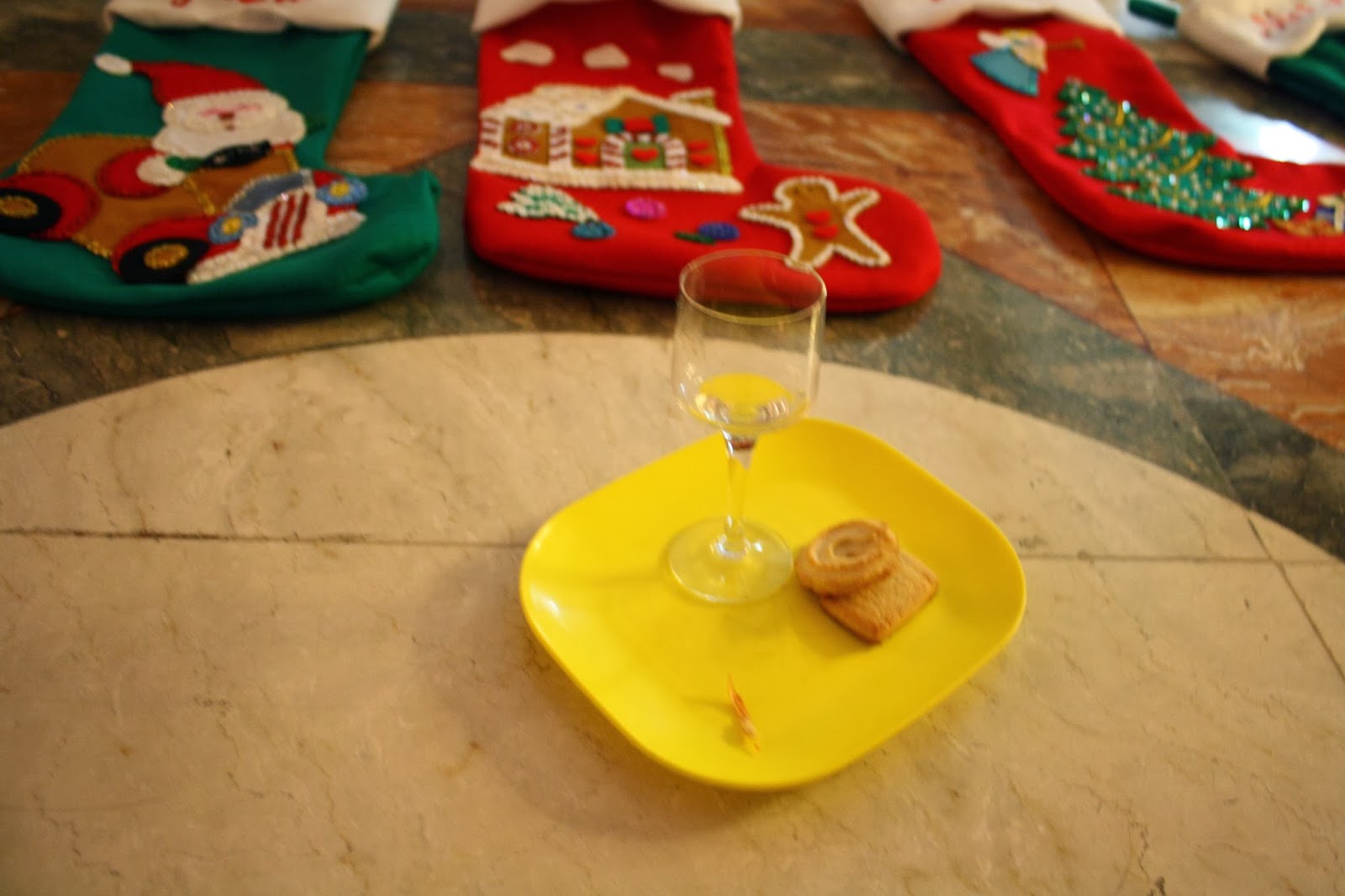
In Nochebuena, we left a nice glass of Champagne and two cookies for Santa to keep him going for the rest of the night.


28 November 2013

Fish and prawn patties. Nick's visit to Tacloban

Yesterday morning Aurelia reminded me her teacher suggested if the children could donate a toy for the children in Tacloban. The toy didn't have to be a special one to them, said her teacher, but any toy would be nice. Also the teacher asked if the kids could bring non-perishable food.

Nick was still in Tacloban and, at the same time I was drinking my coffee (I needed caffeine to be able to function after a broken night with my three kids in my bed since 3.40am), I was preparing Aurelia's lunch box with one of the fish patties (recipe at the end of this post) I made the night before. Aurelia came into the kitchen with the donations she was going to take to school: one lemon and a car from Gabriel's toys. Hummm…I had to have a chat with her:

- Aurelia, I think the teacher meant a toy that belonged to you, not to your brother because it is more difficult to give away something that is yours, isn't it? Go to your room, please darling, and choose one of your toys. You have plenty and those kids don't. It will make them very happy, I am sure - I said nicely to Aurelia, trying not to laugh when I saw the car of poor Gab who already donated a few to the church.

- But mum, the teacher said also the toy didn't have to be special, and all my toys are! - she replied very seriously.

Hilarious. It was like the character of the book Olivia which I used to read to Aurelia when we lived in Buenos Aires. Don't worry, in the end, I  added a bit of pressure on her to choose a non-special toy, although it would have been nicer if she had chosen it from her heart. Too much to ask for a 6 year old girl! 

I spent all day cooking: baby food for Gab and soon for Juanan, gingerbread cookies to decorate them later in the afternoon with Aurelia, a big pot of chicken stock and a nice fish pie. Yes, we eat a lot of fish here…we live in an island! 

I wanted to get things ready before Nick arrived from Tacloban in the evening. I knew he would be tired, emotional and physically, and looking forward to a nice home meal. I was excited to see him and nervous to hear about the sad reality lived there. 

Nick arrived midnight when I was deeply asleep so I couldn't talk to him. This morning he showed me the photos of the damage caused by the typhoon Yolanda over breakfast. He went in a huge ship and in a helicopter with the Australian soldiers to help with the tents and other stuff donated. 

He was obviously disturbed and his vulnerability touched by the terrible stories of the people he met: there was a little baby, same than Juanan's age, around 4 months old, who had meningitis. He was going to be transferred to the local hospital which was in a terribly condition. The nurse wasn't sure whether the baby will survive.

Another boy, 5 years old, had the left leg cut off. And many of the people in the hospital had the underbody injured because they tried to escape, running from the massive waves. 

Nick was told that the people of Tacloban didn't expect the typhoon to be a"tsunami" like, just a strong wind. The people who lived next to the sea were not prepared for waves of 3 meters for 3 hours that took houses and everything away. 

We can't avoid the typhoon season in the Philippines ( although we could be more conscious with the climate change), but we can cooperate and help in many ways. Let's hope (and if you have Faith like I have, pray) next year, when the monsoon comes back again, they are better prepared and less or no people dead. But it is being clear Filipinos have an admirable resistance…for how long?
It was a school...


Healthy fish cakes

This is a "fool" recipe I made up based on a recipe from Gordon Ramsay's cookbook Home Cooking. Easy and uncomplicated but at the same time, packed with lots of nutrients from the white and oily fish and vegetables. Perfect for a quick week dinner.
  • 3 slices of smoked salmon
  • 1 big fillet of white fish
  • 100g prawns, uncooked
  • 1 brown onion, chopped
  • 2 tbsp of chopped parsley
  • 2 tbsp dijon mustard
  • salt and pepper
  • 2 big potatoes, 1 carrot, peeled and cut in cubes
  • 2 beaten eggs
  • Home made breadcrumbs.
  • Vegetable or olive oil for frying
  1. Add cold water to a medium saucepan and add salt. Add the potatoes and carrot. Bring it to boil and cook them until soft. Drain the water and mash the potato and carrot together in a bowl. Set it aside to cool.
  2. In a food processor, mix all the ingredients. Season with salt and pepper.
  3. In the potato and carrot mash bowl, mix the fish mixture. 
  4. With a metal spoon and wet hands, make little patties. If it is a bit sticky, keep it in the fridge for 20 minutes. Pass them through egg, making sure there is not egg hanging before coat the patty with breadcrumbs. Place them on a tray. Repeat with the rest of the fish mixture and place it in the fridge for at least 30 minutes to settle the patties (do not freeze as the potato will make the patties watery). When you are ready to eat, leave the patty tray at room temperature before fry them.
  5. Heat the oil until the breadcrumb gets brown in 10 seconds. Fry the patties two at a time and drain them on a kitchen paper.
  6. Serve them hot with some green peas (for example, mixed them with pesto for the kids).
Note: the smoked salmon gives a particular flavor to these fish cakes. If you can't find it, use can salmon or even better, smoked cod or trout

23 November 2013

Simple Sunday lunch. Cinderella story

Gabriel woke up this morning shouting: "yaya!". It was 5.50am on Sunday, the only day of the week the yaya or driver don't come to work.

When I picked him up out of bed a thought crossed my mind and I smiled. I was having this image of the five of us back to Canberra next June, in one of those pretty sterile temporary apartments in Kingston into which the Government puts temporarily returned diplomats to help them to settle back into Australia. 

In that imaginary picture I had I could see Gab saying loudly the same word "yaya!". No one responded. Because there is NOT a yaya in Canberra; dad is at work from 8am after dropping Aure at her new school until who knows what time; and mum is probably cleaning the toilets or doing the dishes and getting ready, in her sport gear (like most of the stay  at home mums) to do the shopping in Coles with him and baby Juanan, driving a second hand car with a GPS next to the wheel in case she gets lost in one of those hideous famous roundabouts of Canberra.

Oh, yes, Gab will have a bit of a shock, and me too, let's be honest.

The diplomatic life reminds me of the classic Cinderella, one of my daughter's favorite books: when you are posted in overseas, Cinderella is dancing with her prince in palace wearing an exquisite dress; when the posting ends after 3 or 4 years, back to Australia, is the chapter when she rushes back to her carriage at midnight, losing her right crystal shoe on the stairs of the palace. Slowly, the carriage becomes a pumpkin, the horses become mice, and her beautiful dress is just dirty clothes.

When I met Nick in Spain, he fitted the stereotype of a diplomat's wonderful lifestyle. Nick was single, the Third Secretary of the Australian Embassy in Madrid, living in a huge old apartment in la calle del Almirante near Chueca suburb. His diplomatic number plate saved him of a couple of fines on the road when he travelled during the weekends with me. He knows Spain better than me or my family. In general, he was enjoying his posting (he was also in one of the best countries of the world! so, why not?).

My family saw this side of the diplomat's life, and got excited for me, even said "you have won la loteria!". But when we left Spain in March of 2003 and moved to Australia with Nick, the story was a bit different that what I expected, and what my mum and two younger sisters expected when they went to visit me in December that year. My mum almost had a heart attack when she saw my freezing cold ex-government cottage in Narrabundah/Canberra, that looked like a dog box.

I was 25, a new bride and a new immigrant. There was not a nice big house with a cleaner and a driver.
 It was so cold that one mornig I had a cut in my hand and I didn't feel it until I had a hot shower in the evening. I also had to wear three jumpers inside the house. I had to ride a bicycle to go to an English course (a one hour ride away), and worked as a waitress in the evenings in a Spanish restaurant, Legends, whose owner had pity on me and gave me a job within 5 minutes of meeting me. I didn't last long in the job, too clumsy.

But, I think my family was right, I have won the lottery with the family Nick and I have created and with the job "both" have that allows us to experience different cultures, meet new people, have strong friendships, and be flexible, adaptable and open minded to the world and circumstances. There is not always rose colour, as we face challenges...but who doesn't?

But life is too short so today I decided to call my yaya to help us for a few hours. Let's enjoy the Cinderella dance until midnight!
 This is our lunch today: a nice open plate of tomatoes with salt, pepper and extra virgin olive oil; a couple of nice green salads; some cheddar cheese with dried biscuits; a few left over empanadas (recipe in the next post) and....my favourite toasted bread rubbed with garlic, a slice of fresh tomato and a couple of sardines in oil on top. Simple, but delicious.


29 October 2013

"Disney Land" fish croquetas. Woman with a mission, again

Originally French, the croqueta (Spanish for croquette) is a brown and crisp cylindric made of chopped meat, fish or vegetables bound with a white sauce or béchamel and coated with breadcrumbs. It is fried and eaten hot.

There is not a Spanish house where someone isn't making croquetas. For the same reason, in any bar in Spain you will always find a tapa or racion of croquetas. It is a classic in the Spanish cuisine. Croquetas de jamon, fish or the pollo, popular amongst children and adultsthey have one golden rule: eat them with your fingers while they are hot, but not too hot that you burn your fingers (and your tongue!).


Nick and the kids are coming back from Hong Kong this afternoon. I am so excited that I woke up this morning at 5am and made a hundred things. Cooking is back again because I will share it with my family. I was sick of eating toast for dinner.

I feel like a woman with a mission again.

Recipe, step by step, of the croquetas de pescado.


  • Warm 1/2 l of whole milk to low heat and add half of an onion stud with a laurel and 3 cloves to infuse the milk that you will use for the béchamel. 
  • When it is warm, place a large piece of white fish (don't use oily fish). Season with nutmeg, salt and pepper. Cook for 5 minutes until the fish is done.
  • Drain the milk in a colander with a bowl underneath. Remove the fish and set it outside.


  • In a small frypan, fry a chopped onion, until soft (do not brown it).
  • In a non-stick pot start making the béchamel or white sauce: make the roux by frying 3 tbsp of unsalted butter with 1 tbsp of olive oil (the oil avoids the butter to get burnt) and 4 tbsp of plain flour. After a few minutes, add the "fish" warm milk, little by little, stirring all the time with a wooden spoon to achieve a smooth sauce. 
  • The white sauce is done when is sticking out from the walls of the pot. Taste for season and nutmeg.
  • Add then the soft onion and the cooked white fish.


  •  Spray oil in a tray and add the warm mixture.
  • Cover it with a plastic film, touching the filling to stop forming a dry and hard surface.
  • Let it cool and settled for a couple of hours in the fridge or overnight.


  • Separate the beaten eggs and the homemade breadcrumbs in two bowls. Sprinkle the flour on the table.
  • Cut the mixture, already settled like jelly, in long rectangles and place them, by one one, on top of the flour.
  • Shape each rectangle into a cylindric shape and cut then into 10cm long (like making gnocchi)..
  • Make sure each piece is well coated in flour before dipped into egg and then in breadcrumbs.
  • When you are done, place the croquetas in a plastic container and leave them outside for 30 minutes. Or place them in the freezer and use them when needed.


  • Heat a large pan with enough vegetable oil to cover the size of the croqueta. 
  • When hot, add 3 or 4 at the same time, but not more because otherwise the temperature of the oil will be reduced and the croqueta will absorb the oil and be greasy and soggy.
  • Drain on a kitchen paper over a rack.
  • Eat them hot with a green salad
Buen provecho!

28 October 2013

Teriyaki salmon. Sunset from the Bilikiki

The house is very quiet, too quiet I would say, and it feels strange. I am not used to the silence since we had the third child. I like the noise that my kids make, when they laugh or cry, because I know they are at home, here with me. Coming from a big family, it is the same noise I grew up with, and it is great.

Nick has taken both kids to Hong Kong, Disney Land. First time for Gab and second for Aure. Nick tells me they are having a great time!

It is healthy to be alone to enjoy that silence. It doesn't happen very often. I try to look for things to do when Juanan is sleeping, like reading and cooking. I finished one of the books that it has been on my bedside table for months. However, I realised that I do not feel like cooking if it is just me who eats. I like to cook, but I like more to share it with my family. 

So I decided to have a tomato bruschetta and to open the Pandora box again, this blog. 

This afternoon I took Juanan for a brisk walk around the village. The weather was lovely, not too hot as it was almost 5pm. It was a pleasure to have that nice breeze on my face, and Juanan seemed happy too. The sun was changing its colour and at this time of the year, when "winter" is around the corner, the heat isn't strong anymore. You can say good bye to the sun around 5.40pm.

While the sunset was in the background, I thought of Solomon Islands, my first official posting with Nick (although we were in a "mission" called RAMSI, not working for the High Commission). I need lots of posts through this blog to share with you my two years of my life there. And I will little by little. For now, I just want to  tell you that in the "happy islands" I tasted for the first time Teriyaki fish in a boat during a 2 days cruise called Bilikiki (if you want to read about it: www.bilikiki.com).

Nick and I just finished the diving course PADI (although the instructor never gave us the actual certification; not that I would use it, but at least frame it to show off). Nick was more excited about diving than me. I tried to, but never liked it. The equipment was uncomfortable and huge for a tinny woman like me and breathing  through that mask wasn't my thing.
Anyway, we went in this Bilikiki cruise with a few friends. We drank, they did some scuba diving and we ate beautiful fresh fish cooked in a sweet soy sauce called teriyaki. We also had sushi and sashimi. They were Japanese names I never heard of. 
While I was liking the teriyaki sticky sauce from the fork, the pink and orange sunset was so close that you could actually touch it, except for the fact that you would burn your fingers. It was one of those images for a post card "Wish you were here".
The colour of this dish reminds of that sunset and the good moments Nick and I had in Solomon Islands.

PS: Aurelia nd Nick are not very fond of oily fish like salmon. It is too fishy for them. I discovered this recipe and when I cook teriyaki salmon, they ask for seconds.
Teriyaki salmon
Recipe of Gordon Ramsay

  • A knob of fresh root ginger, finely sliced
  • 2 garlic cloves, peeled and finely sliced
  • 3 tbsp soy sauce
  • 2 tbsp maple syrup 
  • 1 tbsp mirin or rice wine (otherwise, I used 1 tbsp of white vinegar diluted with a teaspoon of water)
  • Olive oil
  • About 500g of salmon filets
  • sea salt and ground pepper
  1. In a small bowl, mix the ginger, garlic, soy sauce, maple syrup and miring. Then drizzle with olive oil.
  2. Place the salmon fillets in a dish, season with salt and pepper and pour the sticky dressing over them. Cover with plastic film and set in the fridge to marinate for up to two hours, but at least 20 minutes.
  3. Place a large heavy frying pan over a medium heat and add a dash of oil. When hot, add the salmon skin side down, reserving the marinade. Cook for 2 minutes, then pour in the marinade and cook until the fillets are opaque halfway up the sides. Turn them over and cook on the other side for 4 minutes, basting with the sauce so that the salmon is well coated. Add a bit of water if the sauce is to thick


Notes

  • Do not forget to heat the frypan first until very hot and then add the oil.
  • Remember always to cook fish skin-side down at first to protect the delicate flesh from too much heat. And don't be tempted to move it all the time. Just twice.
  • Teriyaki is Japanese for poultry, fish or meat marinated in a sweet soy sauce preparation and grilled so that marinade forms a glaze.
  • This Salmon is the king or chinook which is the largest. Its meat is firm and very flavourful
  • Serve it with a simple salad of rocket or roasted tomato. Also nice with plain rice and steamed broccoli.

23 October 2013

Maya-maya knocks on the door. Crispy Fish fingers, as my dad used to make

My father, Juan Andres, was born in Huelva, in the South of Spain. It is not the prettiest provincia in the country, but it has beautiful beaches, like Punta Umbria, the most delicious prawns I have ever had in my life and the tastiest jamon in the world: Jamon de pata negra from Jabugo. But this is something I will talk about it in another post.

My parents were divorced when I was 8 years old so my siblings and I used to spend part of the summer with my dad in Punta Umbria. I have very fond memories of that fishing village (nowadays I am sure it is completely different) and those hot summers on the beach. I remember when my father took me and my siblings to the fish market very early in the morning, just a while after the pescadores arrived from faenar (slang for working), and bought fish for lunch. He taught us how to select good fresh fish:

  • fresh and not smelly
  • Eyes clear, shiny (not red)
  • Gills red or pink
  • Flesh firm (we had to touch it to verify it!)
  • Scales shiny and tight on the skin.
My father used to say:"If you buy fillets, not the whole fish, odor must be your primary check for freshness!"

The best thing of going with my dad to the market was the hot churros with milk we had back home. Of course, we also had to help him to clean the fish. My favourite fish was sardines, especially a la parrilla (on the grill), although I never liked them with banana, like my dad had for breakfast.

Fish fingers
This is our Thursday night dinner. I also served a plate of steamed broccoli with soy sauce, which Aurelia and I fought for.


Maya-Maya is a white fish from the sea of Palawan or Mindoro. My yaya tells me that if the maya-maya has a strong smell, it comes from the river.

Once a week, at 6am, my driver goes to the fish market of Baclaran and buys me a couple of fresh maya-maya and sometimes prawns. I went with him twice, to meet the fishmonger and introduce my driver Frank. Since I was heavily pregnant and have since had the baby, I stopped going....and now, I would like to go again but I recognise that it is better if Frank buys the fish, as the locals understand each other and Filipinos know a lot about fish!

From this white fish, my yaya and driver make a nice fish soup using also the heads. And I make sometimes fish fingers, fish curry or fish pie...

I am sure most of you know already how to make fish fingers, but not all of you know how my dad made them...

  • 2 white fish fillets, cut into chunky shapes.
  • 2 cups of homemade breadcrumbs or panko breadcrumbs
  • 1 cup of plain flour
  • 2 eggs beaten
  • Olive oil for frying or sunflower oil
  1. Sprinkle the fish with salt, then cover it and keep it in the fridge for half an hour to firm up.
  2. Take three bowls and the flour, egg and breadcrumbs and place them on the table in that order so you won't get confused.
  3. Using kitchen paper, rub any excess salt off the fish. Dust the fish pieces in flour and shake off any excess, then dip in the egg and then the breadcrumbs.
  4. In a frying pan, add at least 1 cup of oil, when hot, fry the fish for 3 minutes until deep golden colour
  5. Drain on kitchen paper.
Notes:

  1. I read somewhere that it is healthier if you use a lot of oil. Believe it or not, the fish will absorb less oil and will be less greasy. 
  2. Homemade breadcrumbs: cut slices of old bread, without crust, and place it in the food processor. In the highest number, mix the bread until fine, like sand.
  3. Panko breadcrumbs are give fried food a light coating that stays crispy for longer.
  4. In the step number 3, it is important that all the excess of the egg is dripped off before you dip the fish in the breadcrumbs.
  5. I grew up with olive oil in my kitchen because Spain is one of the main producers, like Italy. But it is understandable it is expensive to get it.
  6. Don't crowd the pan when you fry the fish, just two pieces at the same time.