Showing posts with label Bread. Show all posts

2 May 2014

Challah bread pudding with Orange blossom honey. A Lego house for Jamaica in Bacolod

Last wednesday was my yaya's birthday. Her name is Jennifer and she is still young, under 30, but already has two kids, a beautiful girl called Jamaica, of nearly 7 years, and a gorgeous 6 months old baby called Jhaira. 

Don't be surprised, it is perfectly normal in the Philippines to have at least 2 or 3 children at that age, or even more. As you know, the population in the Philippines has hit more the 100 million, putting a strain in the country's resources. 

Jamaica lives with her grandma in Bacolod while Jen works in Manila. Bacolod is known by the filipinos as the "city of the smile" and it is in Negros Occidental. Indeed, Jen has a beautiful smile, even when my son performs a tantrum on the floor - though he doesn't so much anymore, thank goodness. More precisely, she comes from Hinigaran, a poor area close to the sea, and that's why Jen is a good swimmer and jumps happily in the pool with my children - not many yayas know how to swim, lucky me (I am not fond of water so much).

Jennifer lives with her baby Jhaira not too far from my house, and has a cousin-yaya to look after her during the day, until Jen comes back home from my house.

Every two weeks, Jen's salary disappears fast. From each pay date, she has to pay the cousin-yaya and send money to her province for Jamaica's maintenance and Jen's brother's scholarship. As you see, there is not much money left to open a savings account. 

Sadly, there are millions of filipino families which are separated - some 10 million of them live and work overseas, not counting those who - like Jen - are separated though they remain in the country.  It is a difficult choice but, in the end, they have to go where they can make a living.

This is a post dedicated to her beautiful daughter Jamaica and the first time she left her province life of Bacolod with her grandma, who also came with her, to spend more than a month in Manila with her mum Jen, during  the school holidays. 

The first day Jamaica came to our house to meet Aurelia, Gabriel and Juanan, was fun and interesting at the same time. She quickly released her mother's hand and held Aurelia's…and soon was dressed up as a princess or jumped on the trampoline or in the pool. It was the first time Jamaica swam in a pool.

I proudly observed how my kids welcomed Jamaica quickly as if she was already part of the family. This friendly attitude from Aure and Gab helped Jamaica to feel comfortable and happy playing with them. Well, it was not to hard to be warm to her because she was as sweet as her mum, always smiling and very polite.

They communicated with Jamaica in English but she replied in hili gaiynon oelongo, the musical dialect of her province. It was funny to listen that conversation English-elongo between them. Children have a magic way of playing and understand each other. Despite my own life experience, the language barrier doesn't exist sometimes!.

In the afternoon, Jamaica had a bath with them. She was totally absorbed in her world playing with the shampoo and the bubbles, while Aure and gab splashed water all over. She didn't like having hot water, only cold, like being in the sea. She didn't want to leave the bath even when it was obvious her skin was all wrinkled. Jen told me it was Jamaica's first bath, ever (in her province, her family uses the sea or the water from a pozo or a well).

It was also the first time Jamaica tried broccoli and yogurt. When I offered her a plain yogurt for dessert, she dipped her finger in it and tested it. Her expression was telling me she didn't like it much so I gave her a chopped papaya, a familiar fruit for her.  

Jamaica has been coming to play almost every afternoon since then. The days she didn't come, my children were upset and they really missed Jaica, as Gab calls her. Aurelia discovered that things that she usually takes for granted, are fascinating for her new best friend but she also tried to understand why Jamaica wasn't living with her mum in Manila, although I explained her the situation. 

When Jamaica left with Jen about 7.30pm, I found Aure playing with Lego.

- What are you building, Aure?
- A house for Jamaica in Bacolod. You see? Here, it's the bath, a big one. And here is the pool, the TV, and a playroom…Do you think she will like it?
- I am sure. You can show it to her tomorrow when she comes again to play with you and Gab. Maybe, you could build a house together and see what it looks like!


I realised that she was, is, and will be the only filipina friend Aurelia has had during our posting in the Philippines (Gab has a couple). Well, it is never too late, I suppose. (Aurelia has some filipino (boy) friends at her school, but no girls.

In my opinion, living a diplomatic life (moving around the world if you want to call it) expands your mind and enriches your life. I just hope one day Aurelia will put into practice, in the best way possible, these cross cultural experiences from meeting new people with completely different backgrounds.

Thank you, Jennifer for allowing me to write a short story about you and your lovely family. All of you will be terribly missed when we leave.


I made up this pudding-cake for Jen's birthday.  It was the first time she had shared it with her daughter Jamaica, but it is a favourite treat for dessert in my family.

The bread I used for this sweet pudding is called Challah which is a Jewish and is eaten during the Sabbat, but it is equally delicious made with Panettone and even brioche.  I like Challah bread because it is dense and absorbs the custard very well. If you want to bother to make the bread, I give you the recipe I used and it is from Charlie Brown (yes, the clothing label) whose book Cooking from the heart helped me to understand and discover the Jewish food (also Ottolenghi's "Jerusalem" cookbook is fantastic).


It is better to start the day ahead (or two if you make the bread at home). I cut thick slices of the Challah bread (or any one white sandwich bread) and place them on top of a rack overnight so they are crunchy and dried in the morning.

Challah bread (it looks like the braid of Elsa in Frozen!!!- Aurelia said excited)
  • 55g caster sugar (I substitue for 3 tablespoons of honey)
  • 7g dried yeast
  • 60ml vegetable oil
  • 2 eggs
  • 500g bread flour
  • Sesame seeds to garnish

  1. Combine sugar, yeast and 250ml warm water in a bowl. Set aside in a warm place for 10 minutes or until the mixture bubbles (if it doesn't the yeast won't work)
  2. Stir in oil, 1 egg, flour, and 1 tbs salt to form a dough. Knead until smooth (I used the Kitchen Aid with the hook attachment for 8 minutes). Place in a oiled bowl and set aside in a warm place until doubles in size.
  3. Knead the dough briefly, then form a loaf. Rise again. Preheat oven 180C.
  4. Cut in three pieces, and straight them as you were making a baguette. Do a braid (or just place it in a bread tin) and brush it with a beaten egg. Sprinkle sesame seeds.
  5. Bake for 45 minutes. Allow to cool on a wire rack.


Preheat the oven 180C


  • Grease a 1l capacity rectangular oven dish with butter. Warm 1l of full cream milk with a vanilla pod (scrape the seeds and add them to the milk; or use 1 teaspoon of vanilla paste or essence) over low heat. In a blender, add the warm (no hot) milk, 4 eggs and 2 egg yolks, 1 teaspoon of cinnamon and a pinch of nutmeg, 30g melted butter, 1/2 cup caster sugar. Blend for 1 minute.
  • Place the challah slices in the oven dish, one behind the other (like a domino game!). Pour slowly the custard mixture and press the bread to make sure all the slices are well soaked.
  • Transfer the dish into the oven and bake until it puffs and a bit brown on top.
  • Drizzle with Orange Blossom honey or any honey you have (or Maple syrup). Serve it warm with blueberries and extra icing sugar.
We ate it with spoon in hand, straight from the dish. No better way.

PS: If it is for a birthday, don't forget the candles!


5 March 2014

Antipasto, Panzanella salad and rosemary focaccia. The two magic words are "please" and "thank you".

My second child, Gabriel, is two and a half years old and goes to a beautiful, lovely and warming school called LIFE. The teachers greet him every morning with a happy smile and a musical tone that makes me feel relaxed and content when I hug him and say I will come to pick you up soon, as always.

After dropping Gabriel off, come back home to feed Juanan, my third one of nearly 8 months, I rush to do the groceries. I read somewhere that "Women go to do the groceries like they were in vacation". It is so true for a home stay-in mum like me, at least. I love walking around the store, pushing the troller, and checking for the ingredients I might use for dinner. 

A few days ago I was planning to make a fish macadamia curry so I use my shopping list with a single item "macadamia nuts" as the perfect excuse to go on a "vacation" to Rustans supermarket. When I was waiting for my turn to weight the bag of macadamias, I had the most uncomfortable and indignant incident since I moved to the Philippines. 

Just in front of me in the queue there was a wealthy, apparently, Filipina old lady with her two yayas escorting her on both sides. The Rustans sales girl was in her twenties but she could be older as Filipinas have this lucky nature of looking always much younger than her real age. 

- Give me 200g of dried cranberries- said the wealthy woman. I noticed she forgot to say please but the young sales girl seemed to take it as normal. 

The girl weighted the bag, made a knot and returned it to the arrogant client who looked at the bag and threw it to her, and said contemptuously: 

- I said 200g, do you have a problem with hearing?

The Rustans sales girl weighted the cranberries again, carefully but with shaking hands. The old lady  yelled at her saying:

-What is wrong with you!!! you didn't stick the price label in the bag!!! 

My blood was already about to boil. I just couldn't be quiet any longer and allow this arrogant woman to think that money can treat people rudely. I touched her shoulder and opened my big mouth:

- Excuse me, this girl might have a hearing problem as you said, which I doubt but in any case it can be fixed. However, your lack of manners cannot be fixed, sadly.

I wanted to keep telling her that she was too old to correct herself anyway, despite her expensive plastic surgery of her face. But I didn't add further comments because then I would become rude too, at her same low level.

What made me sad was what I heard right after the incident. 

When I was pushing my empty troller -I was so distressed that I forgot to buy the nuts!- away from the old woman, her two shocked -but I am sure smiling- yayas and a terrified sales girl whose name I memorised to mention later on to the sales manager as "a highly charming and wonderful girl who assisted me during my shopping" to make sure she didn't lose her job, I heard this apologise I am really sorry ma'am from the poor girl to the rude woman and not to the other way around as it should. 

I think my children are learning at school and not only at home how to treat and respect people, besides the academic subjects. However, I need sometimes to remind my children the two magic words, please and thank you. 

I hope no one in the future have to remind my children the good manners in LIFE like I did to this arrogant woman.

An Italian feast...
Panzanella salad with a Spanish twist


Panzanella or "bread salad" is a rustic Italian salad, from Tuscany, of vegetables and herbs with stale bread soaked in water and squeezed dry or perhaps fried in olive oil. I didn't include the bread because I made the focaccia as accompaniment.
This recipe is based on Jun Tanaka's Charred pepper and tomato salad  which I twisted a bit by adding  sweet cherry tomatoes, some stuffed green olives with anchovies and a few pieces of good tuna in olive oil.

Serves 4
  • 2 yellow peppers
  • 2 red peppers
  • 100 ml olive oil
  • 1 garlic clove
  • a sprig of thyme
  • 1 teaspoon of caster sugar
  • salt and pepper
  • 30 ml of good quality red wine vinegar
  • a handful of cherry tomatoes
  • 20g of capers, rinsed
  • 1 can of tuna in olive oil, drained
  • a few stuffed green olives with anchovies
  • a small bunch of fresh basil, torn
  1. Find a bowl large enough to fit all the peppers and fill with cold water. Place each pepper straight on to the naked flame of a gas ring (like when you make babaganush with eggplants). Blacken the skin all over, turning the peppers for about 5 minutes. Place in the bowl of water.
  2. Rub the peppers with your hands to remove the backbend skin (don't worry if there is some left). Cut the peppers in half, remove the seeds and core and cut in strips.
  3. Heat the oil in a frying pan and gently cook the pepper strips for 2-3 minutes. Add the garlic, thyme and sugar. Season. Cook for a further minutes, add the vinegar and remove to a bowl.
  4. Add the tomatoes, olives, capers, tuna and torn basil to the peppers and mix well. Remove the garlic, if you wish, and the thyme.
Refreshing antipasto


In Itlalian literally means "before pasta" and it is an appetiser or starter but we make it as a light dinner  or Sunday lunch: a plate of good jam on serrano, thinly sliced; a smelly French soft cheese; a green salad with French vinaigrette; a bowl of green olives with almonds marinated in garlic, a bowl of cooked mushrooms in butter, garlic and thyme; and my home-made tomato and chilli chutney…

At home, we also served the antipasti with my focaccia, a flat usually round Italian peasant bread flavoured variously but always with olive oil- that's why it is my favourite bread-. It is similar to pizza but with more dough and less topping. 

Each region in Italy has its traditional flavourings, shapes and styles. This rosemary and spring onion is quite popular. It is a great snack to make in a dinner party not only because it looks fantastic and like you have spent hours working hard in the kitchen, but also the whole house smells wonderful with the rosemary…hence a welcoming atmosphere.
Focaccia with rosemary and spring onions


According to David Tanis, "the focaccia works best if you mix it the night before". I made it in the morning for dinner time and it had a fantastic crunchy texture in the outside but soft inside. This recipe will make a standard baking sheet.

  • 1 1/2 cups lukewarm water
  • 1 tablespoon of active dry yeast (I used 15g of fresh yeast)
  • 3 cups bread flour
  • 2 teaspoons fine sea salt- Check your salt first, there are different kinds of salts. Mine is too salty and  it made this focaccia you see in the photo above too salty too!!! As the American chef Tomas Keller says  in his book Ad Hoc "you are a good cook when you know how to control the salt"-.
  • 1/2 cup of olive oil, plus extra for drizzling
  • 1/2 cup chopped white part of spring onions
  • 1 tablespoon chopped rosemary
  • Coarse salt for sprinkling
  1. Put 1/2 cup of warm water in a mixing bowl. Add the yeast and 3 tablespoons of the flour and stir together. Let the mixture sit ntil it gets bubbly, about 5 minutes.
  2. Add the remaining 1 cup water, the rest of the flour, the salt and olive oil. Stir with a wooden spoon until the mixture gathers into a rough, stick mass. Sprinkle the dough lightly with a bit more flour and knead the dough - I did it in the magic Kitchen Aid-. 
  3. Lightly oil a bowl of medium size - the dough will raise a bit in the fridge-. Cover tightly with plastic wrap and refrigerate for 6-7 hours.
  4. Remove the dough from the fridge and pat and press it into a oiled baking sheet -it is a bit wet,true-. Let it rise for an hour covered well with wax paper.
  5. Preheat ovento 400F. Scatter the spring onions and rosemary evenly across the top of the dough and drizzle with olive oil. Poke little holes over the top of the focaccia. Sprinkle some sea salt.
  6. Bake for 30 minutes until brownish on top. Serve it warm.


24 January 2014

Wheat bread by hand; step by step with photos. The day I became an Australian

Australia Day is the official National Day of my adopted country and it is celebrated on the 26th of January. In Manila, we had a big event last Thursday night at the Peninsula Hotel with a list of around 700 guests. I could only stay for 90 minutes (I had to rush back home to feed Juanan who still refuses to take the pacifier or the bottle!) but at least I distracted myself from home, saw my girlfriends, wore decent clothes so I looked like a woman not a Mama,  and tasted a small snack of delicious Australian roast beef with tomato chutney

What does Australia celebrate? The anniversary of the 1788 arrival of the First Fleet of British Ships at Sydney Cove and raising of the flag of Great Britain by Governor Arthur Phillip. Nowadays, Australia Day reflects the multicultural society (and I am included!) and that's why many citizenship ceremonies welcoming new immigrants into Australian community are held on that day.

My citizenship was on the 4th of June of 2010:


I haven't framed this document yet but I should before it gets lost, ripped or dirty. On that 4th of June I was proud of having finally achieved the citizenship after going through a long annoying process that took 8 years. First, I had the Spouse visa for a couple of years then, I applied for the Permanent visa and four years later, only when I passed the citizenship test, I got the Australian citizenship and kept my Spanish one too.

I must confess I failed the first time I did the citizenship test. One of the questions in the test was compulsory (so you couldn't get it wrong but I did): "Do you have to renounce to your own nationality if you become a member of the Australian Parliament?". Of course I don't, I thought. Well, yes, you have to.

Those years presenting and supporting with legal documentation, medical exams, photographs signed by witnesses and other requirements that I don't remember exactly, to get the different visas were not much fun and created some anxiety. I was convinced the administrative process was going to be easy as I was married to an Australian diplomat but it wasn't from my experience.

When I was still with the Spouse visa many years ago, with not much English, I remember having lived tricky situations especially once when I was at the airport in Sydney, coming back from Spain. I was without Nick, standing at the long  queue waiting for my turn to show the passport to Customs and to get the stamp that it would allowed me to stay in Australia. The Customs officer looked at me unfriendly and suspicious despite my big smile and charming eyes to soften his heart. Those 2 minutes waiting for the officer to stamp my passport made me feel like an student again about to do the final exam. I was sweating like a chicken!! When I heard the sound "damp!!" I was relieved. I run  away afterwards just in case that officer changed his mind!

The celebration of becoming an Australian took place in Canberra during a cold winter day. Nick and Aurelia were with me but no one else, although I wish I had also some family members from my side or Nick's side. The circumstances didn't make it possible. Never mind, I thought of them and they did of me as well. 

There were hundreds of immigrants with their families in the City Hall. We were very anxious for what that big moment meant for us: Immigration couldn't kick us out!; we could work for the government!; we would have a nice quality of life: safe, good food and friendly people!. 

Going upstairs holding my daughter's hand and receiving the document you see above, it is inexplicable. I was proud of myself because I made the step to leave my country, my family and friends to follow my Australian husband around the world. I was naive when I left Spain but I grew up quickly facing all this alone, but with Nick's support, and starting a new challenging life. 

The three of us went to Koko Black cafe in Civic to have a nice hot chocolate with a piece of cake.  A bit of indulging, but there was NOT a better way to celebrate I became an Australian! 


Wheat bread (or sandwich bread)

Start a day ahead

  • 6 cups whole wheat flour, plus additional for the dough
  • 1 tablespoon kosher salt
  • 4 tablespoons light brown sugar
  • 1 large egg
  • 1/4 vegetable oil (I used sunflower oil)
  • 11/4 cups lukewarm water (90F to 100F)
  • 1 1/4 lukewarm whey or whole milk
  • 1 1/2 tablespoon dry active yeast (or 150ml from the starter you have in the fridge)
By hand...

  • Whisk together the flour, salt and brown sugar in the bowl of a stand mixer. In a small bowl, whisk together the egg and oil, then combine the lukewarm water and milk in a separate small bowl. Whisk in the yeast until it is mostly dissolved. Add both the egg and the milk mixtures to the dry ingredients.
  • Use a large wooden spoon and mix vigorously for at least 10 minutes until the flour has been well incorporated. Beat up he dough as you stir. 
  • Turn the dough out on a lightly floured counter and stretch and fold, like in the photos bellow. Let it sit for 10 minutes and repeat the process 3 more times.

    • To be honest, I usually make the first two steps of the dough in the kitchen-aid with less effort, but I wanted to try by hand…and it was a good work out in my arms!

  1. Stretch and fold process


Slow cold raise 
  • Lightly grease a large mixing bowl, place the dough into it, cover with a plastic rubbish bag. refrigerate for at least 24 hours in the fridge.
  • This photo shows you the bubbles of the fermentation that will give the bread its flavour although it isn't too sour because of the buttermilk, egg and sugar added to the dough.


Divide the dough and shape
  • Remove the dough from the fridge 3 hours before you bake it. Lightly dust with flour the table.
  • Cut the dough in equal pieces. I made 6 bread rolls and 1 big sandwich loaf.
  • Flatten each piece into a rectangle and roll it up into a log. Pinch the seam closed and give the log a few rolls on the table. 
  • Place each roll, either in rounds or rectangle shape, into a greased pan, cover loosely with a tea towel and allow to rise at room temperature until double in size. this step is important.
  • Preheat the oven to 350F.


Make a cut
  • Remove the tea towels, spray water over the rolls and sprinkle some flour on top. gently, make a cut with a sharp knife in each roll or three cuts in the loaf so the bread can expand in the oven.
  • Quickly, place the trays in the oven and spray with water the bread to achieve a final crust.
  • Bake for 30 or 40 minutes.


Golden brown


17 January 2014

Sourdough bread. Learning about delayed gratification and self-control

" Cooking is time: like writing, it demands that impalpable seasoning. It takes time, but then time is something we can control. It is an investment, a brilliant use to feed and nurture ourselves and those who care about ".- Mireille Guiliano

Last night, still with the baby's jet lag, I was watching the video of the Standford University marshmallow experiment in the late 1960s by the psychologist Walter Mischel on delayed gratification ( here is the video, by the way: www.youtube.com/watch?v=QX_oy9614HQ‎ ). As you probably know, a child was offered a choice between one marshmallow provided immediately or two marshmallows if she or he waited until the experimenter returned after 15 minutes. 

Many of the children ate the marshmallow. In the follow-up studies, the researchers found that the children who waited the 15 minutes had - apparently - better life outcomes.

I couldn't help but wonder what would happen if the experiment was done with adults - I couldn't find evidence that it had been. How many grown-ups would eat the single marshmallow? We might be surprised by the number. Would I eat the marshmallow? The answer is I would be VERY tempted and I would have to distract my mind with something else to stop looking at the sweet treat. 

Instant gratification and self- control are both tricky in real life,  indeed, more challenging for some people than for others. 

I must confess I want an instant gratification with many things in life, and not only material things. I want things now and to know them at this precise moment. I don't like waiting.

For example, if you give me a present days before my birthday I will open it for sure. 

SInce I met Nick almost 14 years ago, and now that I have my own family, I share some of the Australian and Spanish traditions. Nick and I leave Christmas presents under the tree a few weeks before the 25th of December which I never did before when I was growing up as a child. For me, all the gifts were given on Christmas Eve but for Nick, some gifts were from the family, not only from Papa Noel, and placed under the tree for many days before the 25th.

Our kids seemed fine seeing the presents in the lead up to Christmas Day although they occasionally asked - or I would say beg - if they could open them, " Just a tiny little corner of the wrapping paper to make sure there is something inside, pleassssse ". It is harder for me than for Nick to say NO.

Another example is when I was pregnant three times, I was so anxious for 9 months to meet him or her. But also as I wanted - but did not - to ask in private to the ob-gy doctor the sex of the baby. I didn't find out for the first two pregnancies but I did for the third one, although I kept it in secret as Nick preferred not to know.

And the last example is when Nick and I apply for a posting from the list of postings that the Australian government releases twice a year. Sometimes you are told whether you got a posting or not very quickly, in a month or so, but in general, we have to wait and wait for months…hummm, I don't like that.

However, even it is true that this negative side of my personality needs to be improved with experience in life, when I am in front of food I must say I am in control. Eating balanced meals in moderation is my objective when I plan weekly menus which include homemade dishes that are not expensive, using fresh ingredients. 

I try to teach my family not only to eat to nurture ourselves but also for the pleasure of eating all together around the kitchen table. There is not hurry in eating and the table is cleaned up by all once the last person finishes the dish, not before (which I found rude when people do it either at home or in a restaurant). The conversation flows at the same rythym as the sound of spoons, forks and knives touching gently the plates.

It is important to teach children to eat without anxiety in order to be able to truly appreciate food (and also the work of the cook!) rather than just swallowing it down.

The program of Stephanie Alexander where I worked before I came to Manila teaches also this important aspect of life: the way an adult eats creates an example for the next generation. Appreciation of food is the key. So I think we have a responsibility, as parents, to make sure we set healthy habits in our lives and around us, especially if there are children involved.

I also learnt from my experience as a Kitchen Teacher in Stephanie Alexander 's program that the best way to start those healthy habits in your family is cooking with children. They learn how to make the batter for a cake but also to wait until the cake is made in the oven (although they are always allowed to lick the spoon or bowl!) and it cools down. So the gratification of eating a piece of cake, and not three pieces by the way, will be delayed.

And they haven't been tested with a marshmallow in front of them. There are other and better ways to teach children ( and adults ) about self- control. 

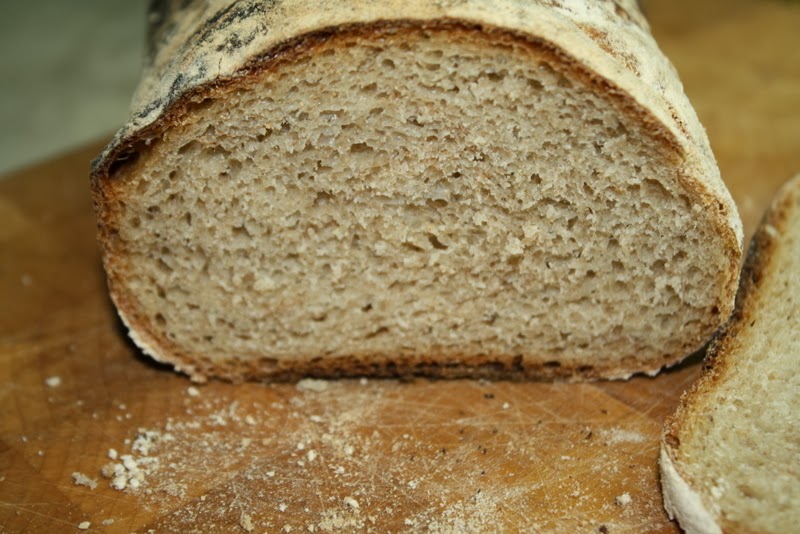
Making bread suits perfectly for this post (and I don't mean using a commercial bread maker). This is the way I make it at home. I can recommend you two good books: Julia Child's Mastering the Art of French cooking Vol II and the River Cottage Handbook No.3 by Daniel Stevens.

 SOURDOUGH BREAD

Prepare the STARTER ahead of time, at least 1 week (the older it gets the better the bread): 
  • Mix together 225g strong white flour (or bread flour which is high content in gluten) and 7g sachet fast-action dried yeast in a large bowl. Using a wooden spoon, gradually stir in 600ml tepid water to make a smooth batter.
  • Cover with a damp cloth and leave for two days, stirring daily and dampening the cloth when necessary to it moist.
  • The starter will be your new child: it needs to be fed regularly every two days by discarding 150ml and replace the same amount with flour and water. Store covered in the fridge. When you are ready to use, bring it back to room temperature and leave to develop for 4 hours.
For the bread I use these ingredients:
  • 675g strong white flour and 1 cup of  strong wholemeal flour.
  • 7g sachet fast-action dried yeast
  • 1 tbsp caster sugar
  • 1 tsp fine salt (not sea salt because it doesn't dissolve properly). You might have to adjust the salt with the practice of making bread
  • 150ml of the starter (it will have separated so you have to stir it before adding it)
  • 500ml tepid water
  • 1 tbsp olive oil


  1. Mix the flour, yeast, sugar, salt together in a large bowl of a kitchen-aid. Add the starter and the tepid water and oil to the dry ingredients. If the dough is too dry, add a bit of water.
  2. Knead for at least 8 minutes until the dough is smooth and elastic and when you press the finger it doesn't get sticky. Shape into a ball and place in a oiled bowl, cover it loosely with a plastic bag to help the raising of the dough until doubled in size.
  3. And from here, the more you raise the dough, deflate it and raise it again, the better the texture of the bread. I usually start the night before and leave in the fridge because a SLOW raise creates a better sourdough, according to my research. And I continue with the raising at least 3 times the next day.
  4. In the last raising, pre heat the oven to 220C.
  5. Grease a large or two bread loaf trays. Remove the dough from the bowl (if it comes straight from the fridge, make sure you wait one hour so the dough is at room temperature before it goes into the oven). Knead it briefly and place it in the loaf tray or any tray you wish.
  6. Cover with a damp cloth and leave to rise until doubled in size. If you were making bread roll, you have to shape them into balls and follow this final step which is important for the gluten to keep developing.
  7. And from now, things go fast. Lightly spray with water the loaf and dust it with flour ( I use spelt flour for this step, but it is optional), using a very sharp knife, slash the top in three places so the bread dough can expand.
  8. I quickly open the oven, spray more water inside to create a bit of moist (professional ovens already have that magic setting to produce the crispy outer of the bread). Bake for 25 minutes or until the bread is golden and sounds hollow when tapped on the base.
  9. Transfer to a wire rack and leave to cool. have patience because the bread is actually tastier when it is warm….
This is satisfaction. Gratification. Please, when you make it…don't have self-control; goggle it up!!!!!


Keep it wrapped in a waxing paper at room in the fridge or you can also freezer if it is well wrapped with plastic film ( put it in a preheated oven straight from the freezer).


You could have a go to make bread and learn about timing and patience. You will be amazed of the rewarding pleasure you will experience when you bite the still warm piece of bread made by yourself.  Olive oil on top for me, butter for Nick.

22 October 2013

Brioche bread made in Manila


Brioche is a very indulgent bread. Or is it a cake? I don't know. It is savoury or sweet. Be bread or cake this brioche recipe is one that you have to bake at least once. 

The first time I made brioche was the week after we moved here, to Manila, in September 2011. My kitchen stuff from Australia just arrived. I was so excited to have all my personal effects with me again that I didn't care I was surrounded by hundred of boxes and 7 months pregnant of Gabriel.
I had to find my Kitchen Aid first, and then my cookbooks. I felt like a child opening presents on Christmas day.

My boss in Silo, one of the best bakeries in Australia, used to make delicious brioche. Of course, I don't have her recipe, or even if I had it, I would never have her magic to produce the same fantastic artisan bread and pastries.

This recipe is ok for an amateur like me. 
Brioche bread
  • 375g strong white flour (also called bread flour)
  • 50g caster sugar
  • 7g fast-action dried yeast 
  • 2 tsp salt
  • 100ml milk
  • 3 eggs
  • 175g softened butter, chopped in small pieces
  • egg wash (1 egg beaten with 100ml of milk and a pinch of salt)
  1. Pour the flour into a bowl of an electric mixer. Add the yeast and sugar. Mix on medium speed with the hook attachment. Gradually add the eggs and milk, one at a time, until fully incorporated.
  2. When the dough is smooth and it begins to come away from the edges of the bowl, add the salt and butter making sure it is well mixed.
  3. Once the dough is mixed, remove it from the bowl and transfer it to an oiled large bowl. 
  4. First rise: Cover with film and leave it to room temperature until it doubles in size.
  5. On a lightly floured work surface, deflate the dough to its original size by punching it down. 
  6. Second rise: again, return the dough to the bowl and cover it with plastic film. Let it rise for 1 hour.
  7. Preheat the oven to 180C. 
  8. Take the dough out of the fridge, deflate it and shape it in the loaf tin. Leave it to rise for 30 minutes.
  9. Glaze the risen brioche with the egg wash, making sure it doesn't drip down the sides.
  10. Bake for 25 minutes or until golden brown.
My personal notes:
  • This dough is quite sticky. So be prepared!
  • The trick is to have all the ingredients, except the butter which should be at room temperature, chilled. 
  • I baked it in a loaf tin, although there are traditional brioche tins.
  • If you prefer, after the first rise, you can keep it in the fridge to use it next day. It is better a slow cold raise. 
  • The more you rise and deflate the dough, the better the final texture of the brioche.
  • Do not skip the step number 8. It is important to leave the dough to rise in the tin.
  • You may add sultanas (soaked previously in warm water to make them soft) to make "sultana bread"